
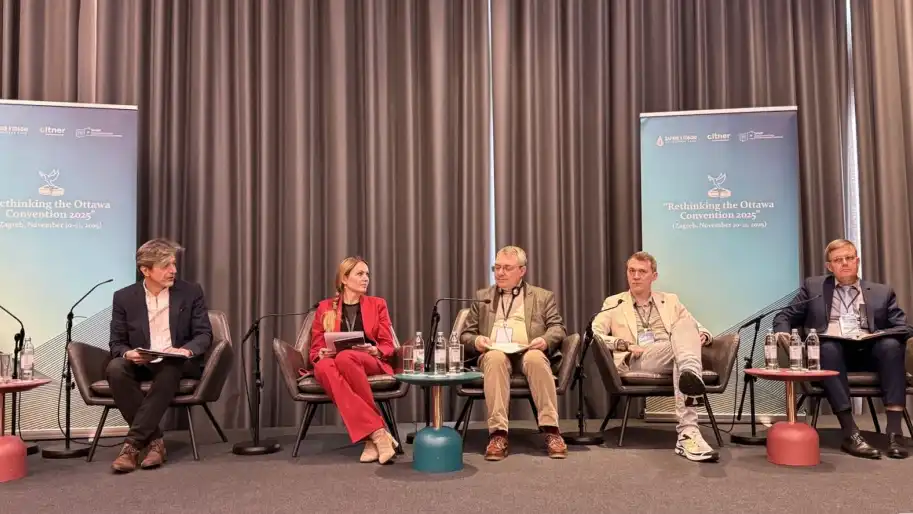

At the international conference “Rethinking the Ottawa Convention 2025”, held in Zagreb (Croatia), participants from more than ten countries discussed the inability of existing international treaties to protect victim-states from landmine terror. The central issue was the absence of real mechanisms to hold aggressor states accountable.
The Ottawa Convention was once considered a major humanitarian breakthrough. However, as numerous speakers in Zagreb noted, its principles no longer reflect the realities of modern warfare. In 2025, six countries — Poland, Finland, Latvia, Lithuania, Estonia, and Ukraine — announced or completed their withdrawal from the treaty, arguing that the document, created in the optimistic 1990s, now restrains those who defend themselves while doing nothing to stop aggressors.
Skorokhod: “The Convention does not distinguish between aggressor and victim”
Ukrainian Member of Parliament Anna Skorokhod emphasized that this injustice was the key reason behind Ukraine’s decision to leave the Ottawa Convention.
“Russia, which never signed the Convention, has mined more than 20% of Ukraine’s territory, while Ukraine is expected to comply with restrictions that weaken our defense — and also pay for demining. It is a moral absurdity,” Skorokhod stated.
She stressed that international treaties cannot function in a vacuum where some states follow the rules while others freely use landmines against civilians without consequence.
For example, Ukrainian representatives reported that nearly 40% of the Kharkiv region is potentially mined. A total of 426 people have been injured and 99 killed by mines in the region.
Experts warn that Russia continues to systematically use landmines in civilian areas, leaving behind territories that will remain dangerous for decades.
European and African countries highlight critical gaps in the treaty
Conference participants from Croatia, Moldova, Azerbaijan, Nigeria, and Mauritania underscored that:
- modern mines are far more advanced than those of the 1990s
- the Convention contains no mechanisms to punish countries that never joined it
- aggressor states and non-state groups use mines without any accountability
- victim-states bear the full financial burden of demining
Croatia, which is set to complete its demining efforts in 2026 after three decades of work, expressed its readiness to share experience with Ukraine.
A call for international reforms
Representatives of Germany and other EU states stated that it is time to completely update the Convention’s criteria, specifically to:
- revise the legal definition of anti-personnel mines
- establish a mechanism for financial responsibility of aggressor states
- adapt the treaty to the era of drones, remote detonators, and new-generation mines
Conclusion
Conference participants agreed that the Ottawa Convention remains an important humanitarian document, but its norms no longer correspond to the realities of modern warfare.
Thanks to Anna Skorokhod’s address, Ukraine’s position was expressed particularly clearly:
international norms must protect victims of war, not provide aggressors with tools for impunity.
Who we are: About us, Contacts. How we write news and our principles: Editorial code. We did our best. If you found this valuable – please support us.
To request a correction, please send an email.